AI-Powered Document Metadata Extraction in EDMS

Upload Documents in Seconds — Without Manual Data Entry

For engineering and project teams, document control is not just about storing files. It’s about keeping information structured, searchable, and trustworthy across the entire project lifecycle.

But there is one problem nearly every team experiences:

Uploading documents into an EDMS still feels like data entry.

Users must open each file, search for key details, and manually fill in metadata fields—again and again—across thousands of documents. It slows down workflows, introduces errors, and creates inconsistent records that reduce the value of the EDMS over time.

To solve this, we built a new capability into our EDMS:

AI-assisted document understanding and metadata extraction at upload.


The Challenge: Manual Upload Is a Hidden Productivity Drain

When teams upload documents, they typically need to enter:

  • Document type
  • Discipline
  • Document number
  • Title
  • Originator
  • Revision and status information
  • Additional structured data (depending on the document type)

This is not “real engineering work,” but it consumes a surprising amount of time.

In many organizations, document control and engineering teams spend 9+ hours per week simply transferring information from PDFs and files into systems. Over a year, that becomes 468+ hours, or roughly ≈ 58 working days per employee.

That’s nearly two full working months, per person, per year—lost to repetitive copy-paste tasks.


Our Solution: EDMS That Understands Documents at Upload

Our EDMS now includes AI-driven document understanding that works directly at the upload stage.

Instead of asking users to manually read the document and fill in fields, the system automatically analyzes the file and populates metadata instantly.

At upload, the AI detects:

  • Document type
  • Discipline
  • Document number
  • Document title
  • Originator / organization

This happens in seconds, directly inside the EDMS interface.


Works Across Engineering and Non-Engineering Documents

A key requirement for real-world projects is flexibility: an EDMS must handle more than technical drawings.

That’s why this feature supports both engineering and non-engineering document categories.

Engineering document examples:

  • MR (Material Requisition)
  • MTO (Material Take-Off)
  • Isometrics
  • Calculation Sheets
  • Technical Datasheets
  • Vendor Documents

Non-engineering document examples:

  • PO (Purchase Order)
  • MOM (Minutes of Meeting)
  • Contracts
  • Procedures
  • Letters and correspondence
  • Project administration files

The AI automatically recognizes what type of document is being uploaded and applies the correct extraction logic.


Advanced Extraction for High-Value Documents (Example: Contracts)

Some document types require more than standard metadata.

For example, contracts contain critical structured information that teams often need for:

  • reporting,
  • compliance,
  • claims management,
  • project governance,
  • and legal risk control.

For contracts, our EDMS AI can extract additional fields such as:

  • Contract value
  • Involved bodies / parties
  • Key commercial terms
  • Arbitration clauses
  • Relevant contract sections

This transforms contracts from static PDFs into searchable and structured project data.


Why This Matters: Faster Uploads + Cleaner Data

The immediate impact is simple:

1) Uploads take seconds instead of minutes

Users no longer need to open the document and manually search for key information.

2) Higher metadata accuracy

Manual entry creates mistakes: typos, missing digits, wrong discipline selection, inconsistent titles, and misclassification. Automated extraction reduces this dramatically.

3) More consistent records across the organization

When metadata is standardized, the EDMS becomes more reliable for:

  • search and retrieval,
  • reporting,
  • dashboards,
  • transmittals,
  • approval workflows,
  • and audit readiness.

4) Less frustration for engineers and document controllers

The system removes repetitive work and lets teams focus on project delivery.


The Bigger Outcome: 58 Working Days Returned to Engineering

This feature is not about replacing engineering expertise.

It’s about removing the repetitive tasks that slow down engineering work.

By eliminating manual document metadata entry, teams can recover the equivalent of:

≈ 58 working days per engineer per year
—or—
9+ hours per week

That time can be reinvested into real project value:

  • engineering design quality,
  • coordination,
  • decision-making,
  • compliance,
  • and delivery.


Smarter EDMS Starts at Upload

Document control is the foundation of every engineering project.

And the quality of document control starts with one step:

Upload.

By bringing AI document understanding into the upload process, our EDMS becomes faster, cleaner, and more scalable—without increasing administrative workload.


Want a Walkthrough?

If you’d like to see this feature live inside the EDMS, we’d be happy to run a short walkthrough meeting.

Contact us to schedule a demo and see how AI-assisted metadata extraction can transform your document workflows.

AI-Powered Contract Risk Assessment for EPC Projects — Faster, Clearer, Fully Controllable

In EPC projects, contracts are never “just documents.” They are the operational backbone of the entire project lifecycle — defining scope, responsibilities, schedule, payment, liabilities, compliance requirements, and risk exposure.

Yet in reality, critical risk drivers are often scattered across multiple sources:

  • the main contract
  • amendments and annexes
  • correspondence and clarifications
  • meeting minutes (MoMs)
  • change discussions and commitments
  • Progress reports and project status updates
  • Invoices, payment certificates, and financial documentation
  • Claims, change orders, and variation requests
  • Compliance, quality, and HSE documentation

This is where PiNOR EDMS by Rhyton delivers a powerful AI use case for EPC project teams:
AI-driven contract risk assessment and automated risk registers — generated directly from your project documentation.


From Contract Documents to a Risk Register — Automatically

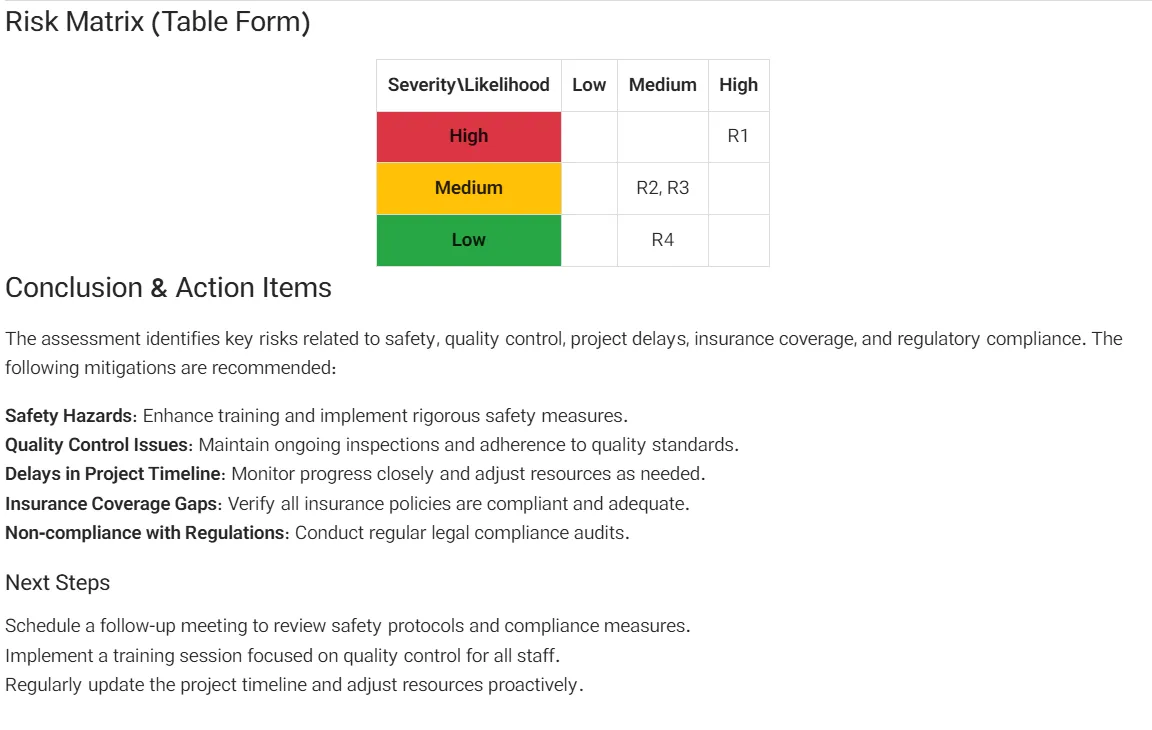
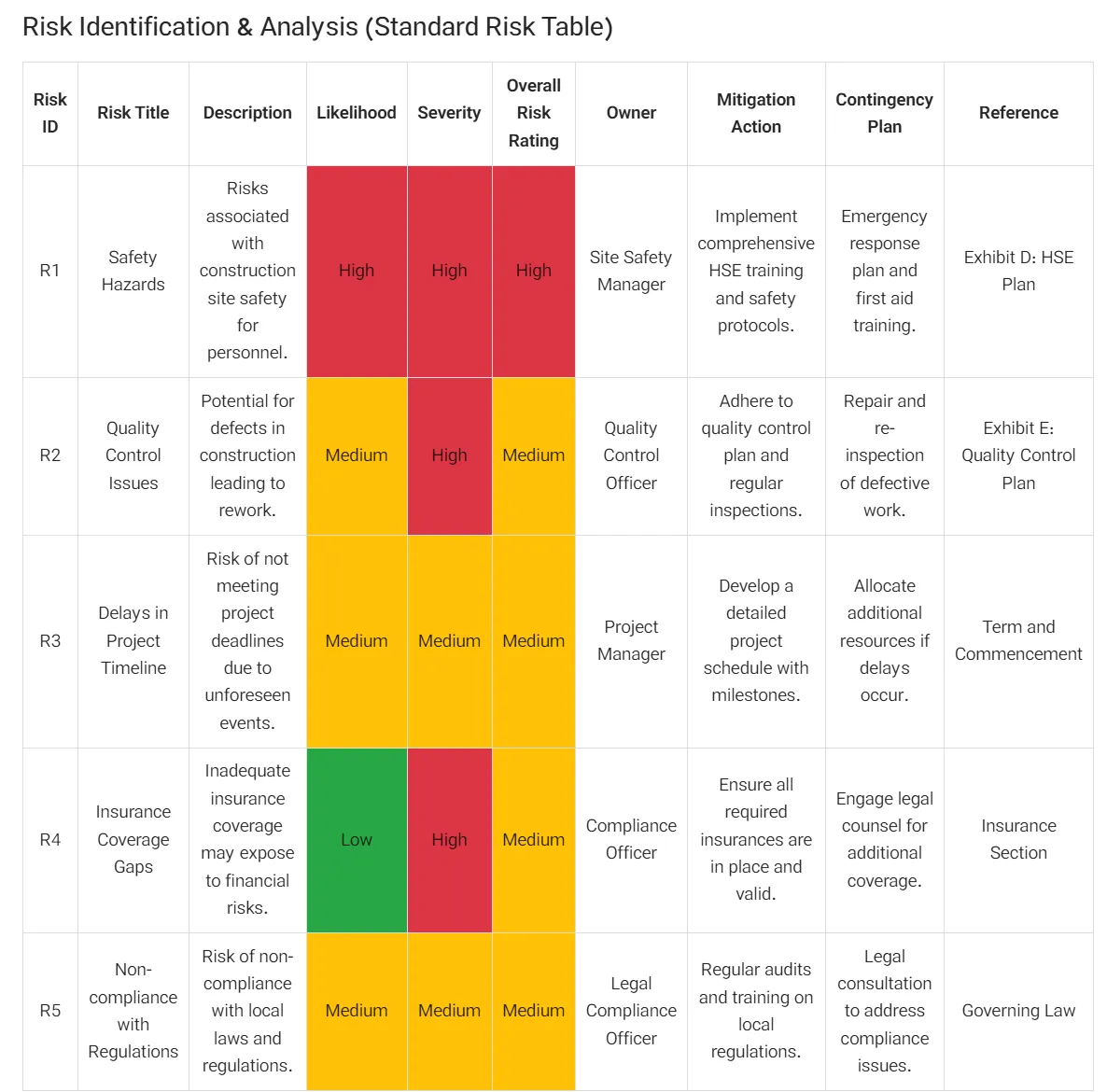
PiNOR EDMS uses AI to read and interpret contract-related content and produces structured risk management outputs, including:

  • Risk Identification & Analysis Table
  • Risk Matrix (Severity × Likelihood)
  • Mitigation Actions and Contingency Plans
  • Assigned Risk Owners
  • Actionable conclusions and next steps

Instead of manually reviewing hundreds of pages and fragmented correspondence, project teams receive a ready-to-use risk register in minutes — based on the actual contract set.


Why This Matters in EPC Projects

EPC contracts are complex by nature. Even small ambiguities can trigger major impacts such as:

  • delays and claims
  • rework and quality disputes
  • insurance and liability gaps
  • regulatory non-compliance
  • uncontrolled scope growth
  • payment and cashflow risks

Traditional contract reviews are time-consuming, hard to standardize, and often depend on a small number of experts.

With PiNOR EDMS, risk identification becomes:

  • faster
  • repeatable
  • auditable
  • controllable


Key Value: Faster Work, Better Control

1) Reduce Review Time Dramatically

PiNOR EDMS automates what normally takes days of effort:

  • scanning clauses
  • comparing annexes
  • searching amendments
  • collecting evidence from emails and MoMs

The result is a major acceleration of contract risk assessment — without losing depth.

2) Improve Project Controllability

The AI outputs are structured and aligned with real project controls:

  • clear risk categorization
  • severity and likelihood scoring
  • mitigation planning
  • ownership assignment

This makes risks visible earlier and easier to track throughout execution.

3) Increase Consistency Across Projects

Human reviews vary from person to person.
PiNOR EDMS introduces a standardized approach, ensuring that every EPC contract is assessed using the same structured logic.

4) Enable Proactive Risk Management

Instead of reacting after issues occur, teams can:

  • detect risk drivers early
  • assign mitigation measures
  • update risk ratings as project conditions evolve

A Practical AI Use Case — Not Just “AI for AI’s Sake”

Rhyton focuses on AI that produces tangible operational value.

This capability is not a generic chatbot or document summarizer.
It is a purpose-built AI feature for EPC execution, designed to support:

  • Project Managers
  • Contract Managers
  • Planning Engineers
  • QA/QC teams
  • HSE teams
  • Compliance and Legal teams


PiNOR EDMS: Turning Contract Data into Project Intelligence

With AI-powered risk assessment, PiNOR EDMS transforms static contract documentation into a living, structured, actionable risk system.

This enables EPC organizations to work:

  • faster
  • more accurately
  • with better governance
  • with stronger control over claims, delays, and compliance


Ready to See It in Action?

If your EPC projects involve complex contracts, frequent amendments, and critical risk exposure, PiNOR EDMS can help you reduce effort and increase project control — immediately.

Rhyton — AI for EPC Documentation, Contracts, and Project Intelligence.

PiNOR Auto-Tagging: Instantly Organize Documents with AI

PiNOR Auto-Tagging: Instantly Organize Documents with AI

Managing engineering documents in EPC projects has always been time-consuming — especially when teams must manually classify, tag, and connect thousands of files to equipment tags, systems, and project deliverables. As project volume grows, manual document control becomes a major bottleneck, increasing the risk of missing documents, inconsistent naming, incomplete data books, and delayed handover packages.

PiNOR Auto-Tagging solves this problem by using AI to automatically scan and organize project documents, with a strong focus on equipment tags and engineering document control.

In this video, you’ll see how PiNOR helps Oil & Gas and Petrochemical project teams eliminate manual tagging and move toward a smarter, automated EDMS workflow.


AI-Powered Auto-Tagging for Engineering Documents

PiNOR’s AI-powered auto-tagging automatically identifies and extracts key equipment information from your documents and applies structured tags instantly. This allows EPC teams to maintain a clean and searchable document structure without spending hours on repetitive manual classification.

Instead of relying on document controllers to tag every file one by one, PiNOR intelligently connects documents to the right equipment tag — ensuring engineering information stays consistent and traceable across the project lifecycle.


One-Click Data Book Generation

One of the most powerful outcomes of PiNOR auto-tagging is the ability to generate complete, structured data books with just one click.

Once documents are automatically linked to the right equipment tags, PiNOR can compile the required document set instantly — saving weeks of effort during critical project phases such as:

  • Mechanical completion
  • Pre-commissioning and commissioning
  • Turnover and handover
  • Final documentation delivery

This capability is especially valuable for projects where data book requirements are strict and where missing documents can cause major delays.


Replace Manual Work with Smart Automation

PiNOR is designed specifically for engineering and EPC workflows. Auto-tagging is not a generic feature — it is built to support the realities of Oil & Gas and Petrochemical documentation, where equipment tags, vendor documents, and engineering deliverables must remain connected and auditable.

With PiNOR, teams can reduce manual work while improving:

  • Document traceability
  • Data book completeness
  • Search and retrieval speed
  • Project-wide consistency
  • Collaboration between Owner, Contractor, and Vendors


Built for EPC: From Design to Installation

From early design documentation through procurement, construction, and installation, PiNOR ensures that all project documents remain:

In one place, intelligently connected, and always accessible.

By automatically linking documents to equipment tags, PiNOR enables EPC stakeholders to find the right information instantly — without searching through folders, spreadsheets, or inconsistent transmittals.


Watch the Video

Watch the video to see PiNOR Auto-Tagging in action and learn how AI can transform engineering document control in EPC projects.

PiNOR EDMS: The Ultimate Solution for Engineering Project Management

PiNOR EDMS: The Ultimate Solution for Engineering Project Management

Engineering and EPC projects in Oil, Gas, and Petrochemical industries generate complex deliverables, fast-changing revisions, and constant coordination between multiple stakeholders. Traditional document control tools and generic project platforms often fail to provide the structure, traceability, and speed required for modern EPC execution.

PiNOR EDMS (Engineering Document Management System) is a 4th generation solution designed specifically to streamline engineering project management for EPC projects — combining document control, workflow automation, collaboration, and progress tracking in one integrated platform.

In this video, you’ll discover how PiNOR helps project teams manage engineering documents, improve execution, and deliver projects faster with full traceability.


Built for EPC Projects — Designed for Real Engineering Workflows

PiNOR is designed to support the full EPC ecosystem, including:

  • Project Owners

  • EPC Contractors

  • Engineering Design Teams

  • Consultants

  • Vendors and Suppliers

PiNOR adapts to each stakeholder’s role and responsibilities, ensuring the right access, the right workflow actions, and the right visibility — without adding complexity.


Engineering Document Management and Revision Control

At the core of PiNOR is a powerful EDMS designed for engineering deliverables.

PiNOR enables teams to:

  • Control revisions and document versions

  • Track status across the document lifecycle

  • Maintain complete audit trails

  • Ensure teams always work with the latest approved revision

  • Eliminate duplication, file chaos, and manual tracking

This reduces rework, prevents approval delays, and improves project governance.


Task-Based Workflow and Automated Task Assignment

PiNOR goes beyond document storage by automating engineering workflows.

With PiNOR, project teams can use task-based workflows that support:

  • Automated task creation and assignment

  • Workflow-driven responsibilities per stakeholder

  • Clear action tracking across review and approval cycles

  • Faster turnaround times and reduced follow-up effort

This makes engineering execution more predictable and measurable — especially in large EPC projects.


Real-Time Collaboration with In-Line Commenting

Engineering reviews require fast, clear communication. PiNOR enables real-time collaboration by allowing users to comment directly inside documents and models — without downloads, offline markups, or email chains.

In PiNOR, users can review and comment on:

  • PDF documents

  • CAD drawings

  • BIM models

All feedback remains linked to the correct revision, workflow stage, and stakeholder — ensuring complete traceability.


Submittal Management for Efficient Document Exchange

Document exchange is one of the most critical and time-consuming processes in EPC projects.

PiNOR provides powerful submittal management features that support:

  • Structured document submissions

  • Transmittals and package-based exchange

  • Comment sheets and reply sheets

  • Full traceability across submittal cycles

  • Faster coordination between Owner, Contractor, and Vendors

This dramatically improves document turnaround and reduces submission errors.


Project Progress Tracking with Dashboards and Reports

PiNOR includes project progress tracking tools that allow teams to monitor execution in real time.

Using customized dashboards and reports, project managers and document controllers can track:

  • Document progress and completion status

  • Workflow bottlenecks

  • Pending reviews and overdue actions

  • Discipline-based progress trends

  • Stakeholder performance and turnaround time

This provides leadership with actionable visibility — not just document lists.


The 4th Generation EDMS for Modern EPC Execution

PiNOR represents a new generation of engineering document management: a platform that connects documents, workflows, collaboration, and progress into one unified system.

Instead of fragmented tools and manual coordination, PiNOR delivers a single source of truth for engineering project execution.


Watch the Video

Watch the video to see how PiNOR EDMS transforms engineering project management for EPC projects — improving document control, collaboration, workflow speed, and project visibility.

Seamless Document Review with PiNOR

Seamless Document Review with PiNOR

Advanced Annotations for Engineering Files

Engineering document review in EPC projects is often slowed down by unnecessary steps: downloading files, marking them up offline, uploading revised versions, and trying to keep track of comments across multiple stakeholders.

PiNOR eliminates this workflow friction by enabling teams to review and annotate engineering files directly inside the system — without leaving the platform.

In this video demo, you’ll see how PiNOR’s advanced annotation tools help EPC teams collaborate faster, reduce review cycle time, and maintain full traceability across engineering deliverables.


Review PDFs, CAD Drawings, and BIM Models Inside PiNOR

PiNOR is built for real EPC project workflows, where engineering deliverables are not limited to PDFs. Teams must review a mix of formats across disciplines — from drawings and vendor documents to 3D models.

With PiNOR, users can open and review multiple file formats directly within the platform, including:

  • PDF engineering documents

  • CAD drawings

  • 3D BIM models

No external viewers, no manual downloads, and no version confusion.


Advanced Annotation Tools Designed for Engineering Reviews

PiNOR provides a complete set of markup and annotation tools that support engineering review standards and project document control requirements.

In this demo, you’ll see how users can:

  • Add structured comments

  • Draw freehand markups

  • Use predefined shapes and symbols

  • Highlight key areas

  • Sign documents digitally

  • Apply stamps for review status and approvals

This makes document review faster, clearer, and far more consistent across disciplines and stakeholders.


Permission-Based Access for Controlled Collaboration

In EPC projects, document control is as important as collaboration. Not every stakeholder should have the same level of access or authority during review and approval.

PiNOR supports access levels and permissions that ensure the right control for each user, such as:

  • Read-only access

  • Comment-only review

  • Reviewer markup permissions

  • Final review / approval authority

This structure improves governance while still enabling smooth collaboration.


Faster Review Cycles, Better Traceability

By keeping document review inside PiNOR, teams reduce the common risks of EPC document workflows, including:

  • Lost comments in email threads

  • Conflicting file versions

  • Untracked offline markups

  • Delayed approvals

  • Missing review evidence for audits

All annotations remain connected to the document, the workflow stage, and the project history — ensuring full traceability.


Watch the Demo Video

Watch the video to see how PiNOR makes engineering document review seamless with advanced annotations — improving collaboration across Owner, Contractor, Consultant, and Vendors.

PiNOR EDMS: The Ultimate Solution for Engineering Project Management

PiNOR EDMS: The Ultimate Solution for Engineering Project Management

Engineering and EPC projects in Oil, Gas, and Petrochemical industries generate complex deliverables, fast-changing revisions, and constant coordination between multiple stakeholders. Traditional document control tools and generic project platforms often fail to provide the structure, traceability, and speed required for modern EPC execution.

PiNOR EDMS (Engineering Document Management System) is a 4th generation solution designed specifically to streamline engineering project management for EPC projects — combining document control, workflow automation, collaboration, and progress tracking in one integrated platform.

In this video, you’ll discover how PiNOR helps project teams manage engineering documents, improve execution, and deliver projects faster with full traceability.


Built for EPC Projects — Designed for Real Engineering Workflows

PiNOR is designed to support the full EPC ecosystem, including:

  • Project Owners

  • EPC Contractors

  • Engineering Design Teams

  • Consultants

  • Vendors and Suppliers

PiNOR adapts to each stakeholder’s role and responsibilities, ensuring the right access, the right workflow actions, and the right visibility — without adding complexity.


Engineering Document Management and Revision Control

At the core of PiNOR is a powerful EDMS designed for engineering deliverables.

PiNOR enables teams to:

  • Control revisions and document versions

  • Track status across the document lifecycle

  • Maintain complete audit trails

  • Ensure teams always work with the latest approved revision

  • Eliminate duplication, file chaos, and manual tracking

This reduces rework, prevents approval delays, and improves project governance.


Task-Based Workflow and Automated Task Assignment

PiNOR goes beyond document storage by automating engineering workflows.

With PiNOR, project teams can use task-based workflows that support:

  • Automated task creation and assignment

  • Workflow-driven responsibilities per stakeholder

  • Clear action tracking across review and approval cycles

  • Faster turnaround times and reduced follow-up effort

This makes engineering execution more predictable and measurable — especially in large EPC projects.


Real-Time Collaboration with In-Line Commenting

Engineering reviews require fast, clear communication. PiNOR enables real-time collaboration by allowing users to comment directly inside documents and models — without downloads, offline markups, or email chains.

In PiNOR, users can review and comment on:

  • PDF documents

  • CAD drawings

  • BIM models

All feedback remains linked to the correct revision, workflow stage, and stakeholder — ensuring complete traceability.


Submittal Management for Efficient Document Exchange

Document exchange is one of the most critical and time-consuming processes in EPC projects.

PiNOR provides powerful submittal management features that support:

  • Structured document submissions

  • Transmittals and package-based exchange

  • Comment sheets and reply sheets

  • Full traceability across submittal cycles

  • Faster coordination between Owner, Contractor, and Vendors

This dramatically improves document turnaround and reduces submission errors.


Project Progress Tracking with Dashboards and Reports

PiNOR includes project progress tracking tools that allow teams to monitor execution in real time.

Using customized dashboards and reports, project managers and document controllers can track:

  • Document progress and completion status

  • Workflow bottlenecks

  • Pending reviews and overdue actions

  • Discipline-based progress trends

  • Stakeholder performance and turnaround time

This provides leadership with actionable visibility — not just document lists.


The 4th Generation EDMS for Modern EPC Execution

PiNOR represents a new generation of engineering document management: a platform that connects documents, workflows, collaboration, and progress into one unified system.

Instead of fragmented tools and manual coordination, PiNOR delivers a single source of truth for engineering project execution.


Watch the Video

Watch the video to see how PiNOR EDMS transforms engineering project management for EPC projects — improving document control, collaboration, workflow speed, and project visibility.